Two years after Hind Rajab’s killing in Gaza

This is adapted from a social video I published.

Last year, when I published a video I made about Palestine, I stayed close to my own lane: the documented killings of Palestinian journalists. That’s my trade, my expertise. It’s also considered a war crime.

Over my years of local reporting on economic issues, I’ve received criticism about speaking about geopolitics, and about *not* speaking about geopolitics. So I don’t know what to do other than be honest.

And, to be honest, I keep thinking about Hind Rajab, the little girl in Gaza who was the same age two years that my daughter is today. As Omar El Akkad has written: “There’s no such thing as someone else’s children.”

Continue reading Two years after Hind Rajab’s killing in Gaza

What’s my personal “artificial intelligence” philosophy

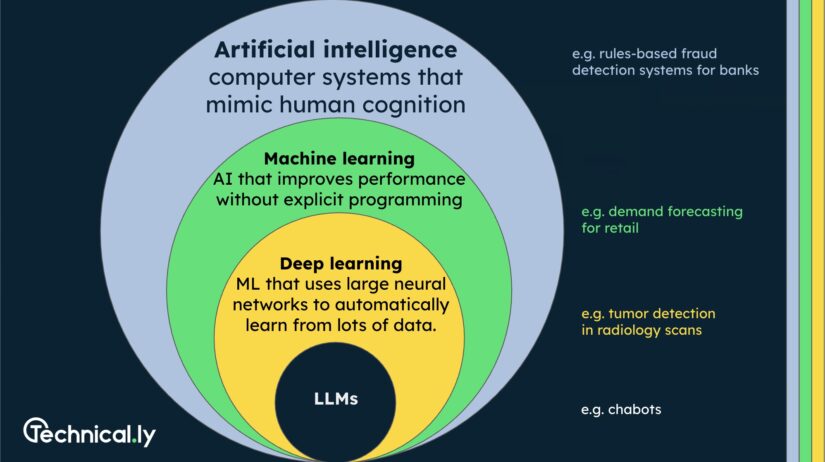
It was summer 2009 that I was first introduced to the idea that robotics and artificial intelligence are two halves of how a machine would move through our world. One is physical motion, and the other is a big term for computer systems that mimic human cognition — from computer vision and probabilistic language to sound mimicry and risk management.

Over the next near two-decades, my reporting and entrepreneurship have evolved alongside a new fast-moving chapter of these technologies we call “artificial intelligence.” I’ve spent at least a decade developing my own relationship to what some have called “the singularity.” Now the last few years have brought this into the mainstream. That’s forced me to develop a more precise view.

Continue reading What’s my personal “artificial intelligence” philosophy

Gubernatorial conversations

I’ve recently interviewed a pair of influential elected officials: Delaware Gov. Matt Meyer and Maryland Lt. Governor Aruna Miller. I filed Technical.ly stories. Find the live recordings of my interviews and links to my reporting below.

The Technical.ly beat once felt less directly state relevant, but that’s shifted in recent years, with the rise of industrial policy and the importance of entrepreneurship. As publisher, I’ve seemed like a good starting point for direct interviewing, though our newsroom has long interacted with these and other elected officials at the state level around policy and one-off engagements. This marks something that will likely be more direct and more frequent now, reflecting our beat’s growing profile.

Continue reading Gubernatorial conversations

Science communication at a crossroads

I joined a spirited conversation at the University of Maryland BioPark for a system-wide symposium on science communication.

I filed a story for Technical.ly here. Our panel looked like this:

  • Megan Nicholson, a senior editor at Issues in Science and Technology
  • Heath Kelsey, director of the Integration and Application Network at the University of Maryland Center for Environmental Science.
  • Christopher Wink, cofounder and publisher, Technical.ly
  • Moderator, Michael Sandler, the UM system’s vice chancellor for communications and marketing

Local stories shape how people in that place feel about their home

The good people at Series B[uffalo], a new entrepreneurship storytelling initiative from that upstate New York region’s innovation-led economic development org 43 North Foundation, interviewed me for their newsletter. I shared that below, and encourage you to check them out.

My perspective is informed by Technical.ly’s ‘case for storytelling.’

Continue reading Local stories shape how people in that place feel about their home

The corporation was invented to serve the people

Apple and Amazon are valued by public markets far in excess of their tangible assets, because of their “intangibles” in R&D and brand recognition. By historic standards, they own very little.

In contrast, AerCap and Prologis are among the world’s largest owners of the “means of production.” One leases aircraft to most large airlines. The other is the world’s largest industrial real estate company, leasing warehouses and data centers. They own the stuff.

Both “are nevertheless rather unimportant intermediaries in the modern economy” that now reflect “a long chain of intermediation” that means the system is more distributed. Yet our view and language about how companies fit into our world hasn’t changed.

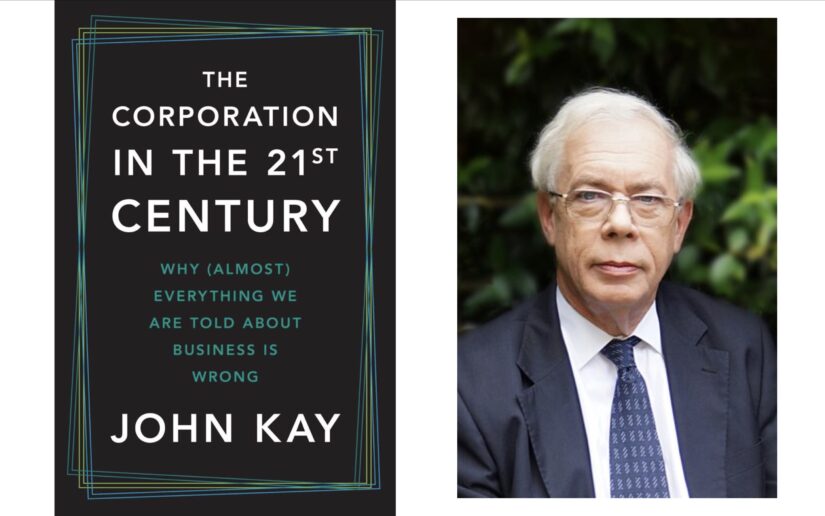
That’s from The Corporation in the Twenty-First Century: Why (Almost) Everything We Are Told About Business Is Wrong, a 2024 book by knighted economist John Kay.

The old industrial meaning of “capital” meant the owned means of production — mills, railways, steel plants, assembly lines. In many modern firms, Kay argues, those assets are fungible, often rented, and less important than the firm’s collective capabilities.

Among his criticisms is how today’s shareholder priority has distracted from the corporation’s origins as a device of the state. Executives can extract value in the short term, but this narrow-mindedness is provably harmful to corporations in the medium term. Business and economics thought has become far too self interested. Its champions treat “collective action” and “collective knowledge” as accidental overflow rather than our truly natural state. The book is thoughtful and important, given that its from among its closest insiders.

Below I have my notes for future reference.

Continue reading The corporation was invented to serve the people

ESHIP “Builder of the Day”

The tribe I feel closest to are the ecosystem builders: those who work their tails off to bring entrepreneurship to the center of local strategy.

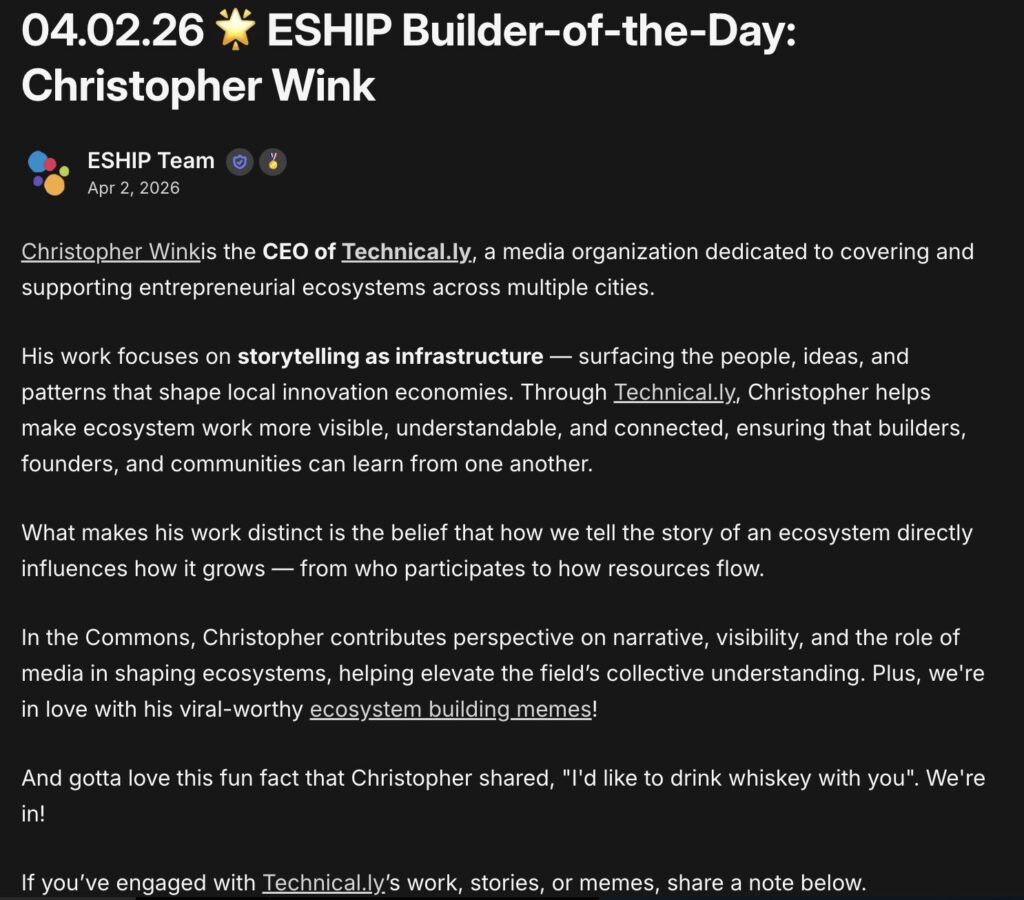
One of the chief conveners is ESHIP Alliance, which is growing an online community of just such ecosystem builders. Smartly, and generously, there they’re highlighting longtime and active ecosystem builders. I’m proud they kindly highlighted my Technical.ly work today.

This is a clever strategy 🙂 Thanks to ESHIP leader-organizers and champions

My foundational political belief: countervailing power

This was originally a social video

What’s your defining political belief?

I’ve been thinking about that because on this app, and others, there’s a loud and often vicious argument among people most Americans would place somewhere left of center. Liberal, progressive, leftist, socialist, Democrat — those words do not mean the same thing, and I usually try not to wade into that labeling fight, either as a journalist or as someone who studied political science.

But I do think there’s a fair and useful question underneath it all: what is your foundational belief? Mine is this: I am deeply skeptical of concentrated power.

Continue reading My foundational political belief: countervailing power

One Day, Everyone Will Have Always Been Against This

Long the most compelling evidence of the net good of the project called “Western civilization” has been the demand for so many to join it. No doubt it’s always included misdirection and dastardly ethical lapses but surely all told the demand showed it was worth it. What happens when that changes?

The author who overlooked the petty indignities because of the remarkable and widespread freedom — of movies and walking into a library unencumbered by fear was thrilling. But the paper thin reliance on Israel over the killing of Palestinian children has broken a growing number of adherents.

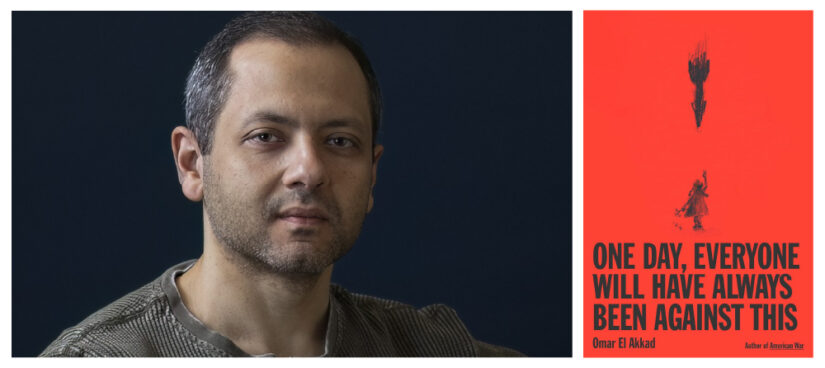
That’s what I kept thinking of while reading One Day, Everyone Will Have Always Been Against This, the February 2025 National Book Award winning lyrical takedown of Western enablement of the Israeli genocide of Palestinians by novelist Omar El Akkad. It is harrowing, and beautiful and imporant.

“This is an account of a fracture, a breaking away from the notion that the polite, western liberal ever stood for anything at all,” he writes, and then later to the western liberal, of which I would likely be considered one: “It’s no use in the end to scream again and again at the cold, cocooned center of power: I need you just this once to be the thing you pretend to be”

Elsewhere: “There’s no such thing as someone else’s children.”

Below I have my notes for future reference.

Continue reading One Day, Everyone Will Have Always Been Against This